A "challenging" trip grade indicates a demanding, high-altitude adventure (often 5,000–6,000+ meters) designed for experienced adventurers with excellent fitness.
|
Quick Overview The Kanchenjunga Circuit Trek 2026 is a 20-day remote Himalayan trekking expedition in eastern Nepal that circles Mount Kanchenjunga (8,586m), the world’s third-highest peak. The trek reaches up to 5,143m and requires a licensed guide and restricted-area permits (RAP + KCAP). It is known for its extreme remoteness, fewer crowds, rich biodiversity, and authentic Himalayan cultural experiences.
|
The Kanchenjunga Circuit Trek 2026 is a 20-day remote Himalayan journey in eastern Nepal reaching 5,143m, requiring a licensed guide and restricted-area permits (RAP + KCAP). This is not a commercial trekking route. It is one of Nepal’s last true wilderness expeditions.
Far away from the busy trekking routes of Everest and Annapurna lies one of the Himalayas' greatest secrets.
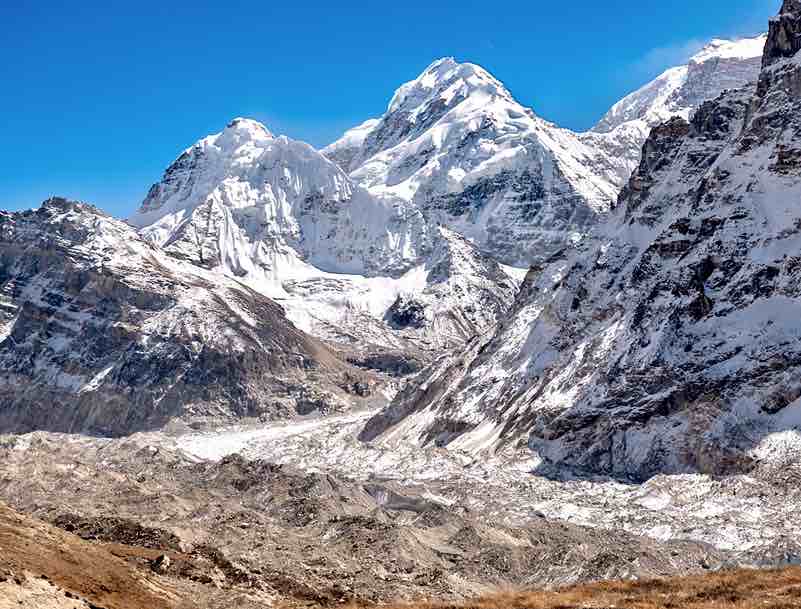
The Kanchenjunga Trek takes you through ancient forests, glacial valleys, remote mountain villages, and dramatic high-altitude landscapes beneath the towering walls of Mount Kanchenjunga.
Unlike more commercial trekking routes, this journey offers genuine wilderness, authentic cultural encounters, and a feeling of exploration that has largely disappeared from modern trekking.
Each day reveals something extraordinary: crossing suspension bridges over roaring rivers, walking through rhododendron forests, sharing tea with local families, and finally standing beneath the immense glaciers of the world's third-highest mountain. The trek passes through remote regions of the Kanchenjunga Conservation Area, including villages like Ghunsa and Taplejung, offering a true remote trekking experience in eastern Nepal.
The trekking route gradually transitions from cultivated valleys to high alpine terrain:
Each stage offers a noticeable shift in landscape, climate, and settlement patterns, making the journey highly varied over its duration.
The Kanchenjunga Circuit Trek combines dramatic mountain scenery, diverse landscapes, and rich Himalayan heritage in one of Nepal's most rewarding long-distance trekking adventures.
For 2 trekkers, the cost is USD 2,200 per person.
For a group of 3 to 5trekkers, the cost is USD 2,000 per person.
For a group of 6 to 9 trekkers, the cost is USD 1,800 per person.
For a group of 10 to 15 trekkers, the cost is USD 1,600 per person.
For a group of 15 to 19 trekkers, the starting price is USD 1,400 per person.
Note: Prices are calculated per person and vary depending on group size. Larger groups benefit from lower per-person rates.
The trail passes through communities influenced by multiple Himalayan cultures, including Rai, Limbu, Sherpa, and Tibetan traditions.
Common cultural elements along the route include:
As a restricted-area trek, the Kanchenjunga Circuit requires advance permit processing, guide arrangements, accommodation reservations, and transportation planning.
Booking early allows you to:
For spring (March–May) and autumn (September–November) departures, we recommend booking at least 2–6 months in advance.
Ready to Explore Nepal's Last Great Wilderness?
| Day | Route / Activity | Elevation (m) | Duration | Day Temp | Night Temp |
| 1 | Arrival in Kathmandu | 1,330 | — | 18–25°C | 8–15°C |
| 2 | Trek Preparation & Kathmandu Sightseeing | 1,330 | Half day | 18–25°C | 8–15°C |
| 3 | Fly Kathmandu → Bhadrapur → Drive to Taplejung | 1,442 | Flight 45 min + 7–8 hr drive | 15–24°C | 8–12°C |
| 4 | Drive Taplejung → Sekathum | 1,650 | 6–7 hr drive | 15–22°C | 7–10°C |
| 5 | Trek Sekathum → Amjilosa | 2,480 | 5–6 hr | 12–20°C | 3–7°C |
| 6 | Trek Amjilosa → Gyable | 2,727 | 4–5 hr | 10–18°C | 2–5°C |
| 7 | Trek Gyable → Ghunsa | 3,420 | 5–6 hr | 8–15°C | -2 to 3°C |
| 8 | Trek Ghunsa → Khambachen | 4,050 | 5–6 hr | 5–12°C | -5 to -1°C |
| 9 | Acclimatization Day (Khambachen) | 4,050 | Optional 2–4 hr hike | 5–12°C | -5 to -1°C |
| 10 | Trek Khambachen → Lhonak | 4,780 | 4–5 hr | 2–10°C | -8 to -4°C |
| 11 | North Kanchenjunga Base Camp → Lhonak | 5,140 max | 6–7 hr | 0–8°C | -10 to -5°C |
| 12 | Trek Lhonak → Ghunsa | 3,420 | 6–7 hr | 8–15°C | -2 to 3°C |
| 13 | Trek Ghunsa → Sele Le Base Camp | 4,240 | 5–6 hr | 4–11°C | -6 to -2°C |
| 14 | Sele Le Base Camp → Tseram | 3,868 | 6–7 hr | 5–13°C | -4 to 0°C |
| 15 | Tseram → Oktang BC → Ramche → Tseram | 4,740 max | 7–8 hr | 2–10°C | -4 to 0°C |
| 16 | Trek Tseram → Tortong | 2,995 | 6–7 hr | 10–18°C | 2–6°C |
| 17 | Trek Tortong → Yamphudin | 1,690 | 6–7 hr | 15–23°C | 7–12°C |
| 18 | Drive Yamphudin → Ilam/Kanyam | 1,115 | 7 hr | 18–25°C | 10–15°C |
| 19 | Drive Kanyam → Bhadrapur → Fly Kathmandu | 1,130 / 1,330 | 5–6 hr drive + flight | 18–28°C | 8–15°C |
| 20 | Departure | 1,330 | — | 18–25°C | 8–15°C |
Upon landing at Tribhuvan International Airport, you will be greeted by our representative with a garland. Then you will have a private transfer to the hotel. After reaching the hotel, you can rest for some time and then go on a short walk near the hotel area or Thamel. But mainly focus on rest and hydration. You can also exchange money and buy a SIM if needed. In the evening, after dinner, sleep early to recover from travel.
On this day, you will stay in Kathmandu to prepare for the long trek and half-day sightseeing. As soon as you have breakfast, you will be picked up by the guide for the Kathmandu sightseeing. During the sightseeing, you will explore Swayambhunath Stupa (Monkey Temple), Pashupatinath Hindu Temple, and Boudhanath Stupa. During the sightseeing, you will learn about Nepali culture, religion, art, and architectural history. Then you will return to your hotel and rest for some time. Afterward, you will be given a full trek briefing where you learn about daily walking hours, altitude sickness symptoms, etc. You will also have a permits equipment check (boots, jacket, sleeping bag). If you need any gear, you can buy or rent it in the Thamel shops. In the evening, you will have final packing for the trek and sleep.
You will wake up early in the morning for the flight to Bhadrapur. Then you will be picked up by the guide and assisted to the airport. The flight takes about 40 to 45 minutes with views of hills, rivers, and plains. As soon as you land at Bhadrapur Airport, you will head to Taplejung. The mountain drive will be long, where you pass local villages and towns, driving through tea gardens. The roads become rough and narrow as the drive continues. You will reach Taplejung in the evening, where you will have your first experience of eastern Nepal. Overnight stay is in Taplejung.
You will have breakfast at your lodge, then start the drive to Sekathum. The drive will be off-road, bumpy, and dusty along the Tamor River. During the drive, you will pass several Rai and Limbu villages, seeing waterfalls and green hills. You will stop at a few small tea shops on the way and reach Sekathum village. You will check into a basic lodge where the facilities are limited. You can have a short walk around the village and talk to the local people. You will have an early dinner and rest for a trekking day.
From this day, your first official trekking day starts. You will trek to Amjilosa from Sekathum. You will start your trek after breakfast. You will trek along the river, crossing suspension bridges. You will also have a jungle trekking experience where you will walk through dense forest, passing bamboo and rhododendron trees, narrow trails along cliffs, and some steep uphill sections. The weather will be humid and warm. After you reach Amjilosa, you will stay at a simple teahouse. In your free time, you can explore villages.
You will start the trek to Gyable, which is a calm trekking day. You will have a morning warm-up walk, then a gradual uphill trek. The trail is quiet and peaceful with fewer trekkers. During the trek, you will cross small wooden bridges and thick bamboo forests. The altitude is increasing slowly as you feel cool air. You will reach Gyable village, having limited lodge options. You can explore villages or rest after the trek.
Today, you will trek from Gyable to Ghunsa, where the trail follows the Ghunsa River. You will trek through pine forests and villages. As you enter Tibetan Buddhist culture, you will see prayer flags, mani stones, stone houses, and yak grazing areas. Before reaching Ghunsa village, you will have an uphill climb. Ghunsa village is the biggest village so far, with better food and lodges. You can explore Ghunsa village and talk to local people about their culture and lifestyle.
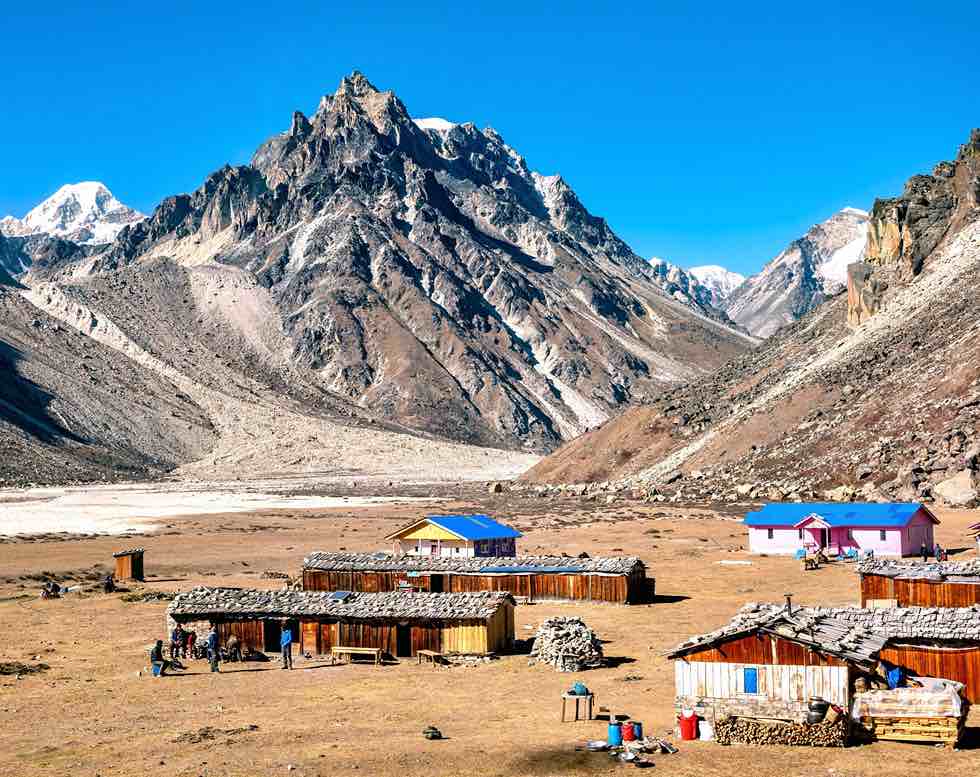
Having breakfast at Ghunsa village, you will trek to Khambachen. You will trek above the tree line, having open mountain views and landslide areas where you must pass carefully. As the high altitude begins, cold winds start, and the weather can change quickly, so walk slowly and drink water. The trails will be drier and rockier. With a view of Mount Jannu, you will reach Khambachen. Due to the high altitude, the night will be very cold. You will have a basic lodge stay at Khambachen.
This day is very important, as you will stay in Khambachen to acclimatize and prevent altitude sickness. You will have a late breakfast and a short acclimatization hike to nearby hills. Practice slow breathing during the hike. After returning to the lodge, rest the whole afternoon and drink warm fluids to keep you hydrated. Make sure you check oxygen levels frequently and prepare for higher altitudes.
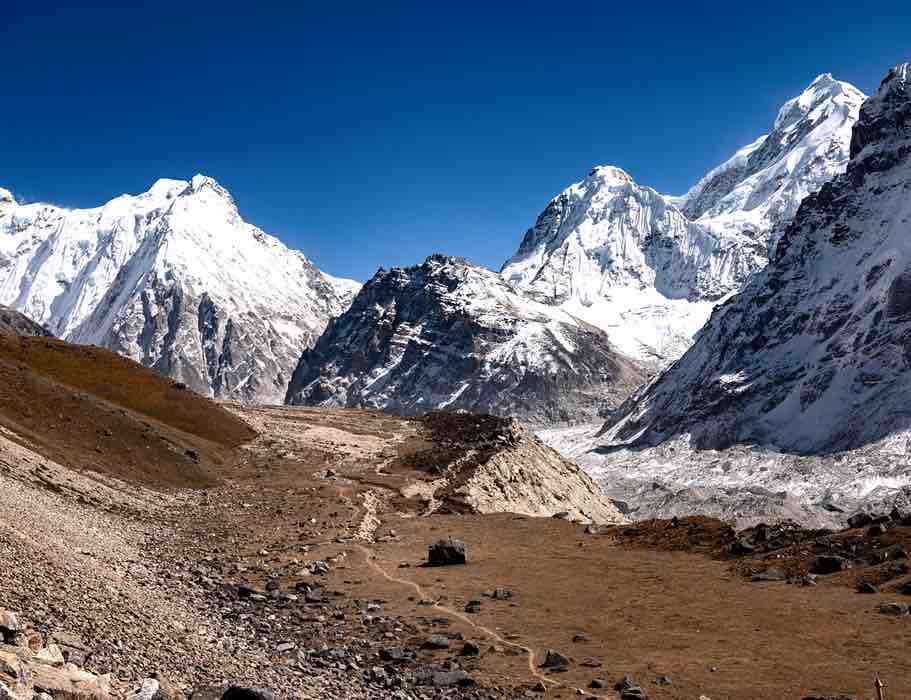
You will start the early trek due to the cold to Lhonak. You will trek through rocky trails and a dry and windy landscape. You will have amazing mountain scenery with glacier views and snow peaks all around. Due to the very high altitude, the air is thin, which is physically demanding, so trek slowly and take frequent rest breaks. With that, you will arrive at Lhonak, which is a high-altitude camp and has cold temperatures.
On this day, you will go on an early morning trek to North Kanchenjunga Base Camp, which is the highest point of the trek. You will pack your bag lightly, then start the slow climb through thin air to the base camp. The terrain of the base camp area is full of glaciers and ice. You will see prayer flags at the base camp and close views of Mt. Kanchenjunga. You will have photo and rest time there, then return to Lhonak. Although it is a long and tiring day, it is one of the most rewarding days. Overnight stay in Lhonak.
You will trek back to Ghunsa from Lhonak, where you will retrace the same route. You will start your trek after breakfast. The trail is followed by long downhill walking, and breathing becomes easier as the altitude decreases. You will have lunch at Khambachen, then continue the trek to Ghunsa. After reaching Ghunsa, you will mainly rest and recover after the long trek.
On this day, you will trek to Sele Base Camp. The trek starts after breakfast, as the trail is isolated, steep uphill, and the forest trails become rocky. Your altitude also increases, where the conditions are cold and thin air with less oxygen. There are a few resting places; because of that, it is also known as a tough trekking day where strong mental strength is needed. Reach the Sele Base Camp, where the night is very cold. Overnight stay in Sele Base Camp.
You will start your trek early in the morning to Tseram, which is also one of the hardest trekking days. During the trek, you will cross high mountain passes: Sele La Pass and Mirgin La Pass. There is a strong wind and the possibility of snow, with an amazing panoramic view of the surroundings. Then, a long descent to Tseram and into the Yalung Valley. Overnight stay in Tseram.
You will have an early breakfast, then start your hike to Oktang Base Camp. You will trek on a glacier trail this day. You will see views of the South Face Glacier and the mountain. Then trek to Yalung South Base Camp (Ramche). Then return to Tseram, where you will complete a very long and tiring day.
You will head towards Tortong from Tseram. The trek is mostly steep downhill forest walking. The trail is forested and mossy, and a slippery path is possible, crossing streams. The temperature becomes warmer as the altitude decreases. You will arrive at Tortong, which is a quiet forest camp.
On this day, you will trek to Yamphudin from Tortong. You will have a long descent where you pass through villages, cross suspension bridges, and see farms and terraces. The temperature becomes warmer as you reach Yamphudin. From this day, your trekking trail ends, and you return to village life. You will have a comfortable rest in Yamphudin.
You will drive to Ilam from Yamphudin after breakfast. You will have a scenic drive through green hills and tea gardens, where you will have comfortable roads. You can stop for photos on the way; you will reach Ilam, which is a beautiful tea region with warmer weather. You will have a relaxed evening in Ilam.
You will have a morning drive to Bhadrapur and fly to Kathmandu. Then you will have airport check-in and a short flight to Kathmandu. After that, you will have a hotel transfer so you can rest after the journey. You will have free time for shopping as you return to the city. In the evening, you will have a farewell dinner in a cultural restaurant with local cuisine and a cultural program.
You will have breakfast and then final packing for departure. According to your departure time, our representative will pick you up from the hotel and drop you off at the airport. With that, your journey in Nepal comes to an end, and your lifetime adventure is completed.
Modify itinerary, accommodation, transportation, or activities according to your travel style and schedule.
The Kanchenjunga Circuit Trek involves a combination of domestic flights and overland transportation to reach the remote eastern region of Nepal.
Accommodation along the Kanchenjunga route is simple and designed for trekkers exploring one of Nepal's most remote regions.
Room Facilities
Note: Additional services may incur extra charges, especially at higher elevations.
The restricted area Himalayan trek is considered a challenging high-altitude trekking adventure because of:
This trek is ideal for:
Weather conditions vary significantly throughout the trek due to the large altitude difference between the lower valleys and the high alpine regions near North and South Base Camp.
Spring is one of the best seasons for the Kanchenjunga Trek. Rhododendron forests bloom across the hillsides, temperatures are comfortable, and mountain views are generally excellent.
| Elevation Zone | Day Temperature | Night Temperature |
| Lower Region (1,000–2,500m) | 15°C to 25°C | 5°C to 12°C |
| Mid Region (2,500–4,000m) | 8°C to 18°C | -2°C to 5°C |
| High Region (4,000m+) | 0°C to 10°C | -10°C to -2°C |
Autumn offers the most stable weather and clearest mountain views, making it the most popular trekking season.
| Elevation Zone | Day Temperature | Night Temperature |
| Lower Region | 15°C to 24°C | 5°C to 10°C |
| Mid Region | 8°C to 17°C | -3°C to 4°C |
| High Region | -2°C to 8°C | -12°C to -4°C |
Winter brings heavy snowfall at higher elevations. Passes such as Sele La may become difficult or inaccessible.
The monsoon season is generally not recommended due to:
For the best overall experience, plan your trek during:
These months offer the safest trail conditions, best visibility, and the most comfortable trekking temperatures.
The Kanchenjunga region is classified as a restricted trekking area in Nepal. Foreign trekkers must obtain special permits before entering the region.
Required Permits
1. Kanchenjunga Restricted Area Permit (RAP)
This permit is mandatory for all foreign trekkers entering the restricted section of the trail.
2. Kanchenjunga Conservation Area Permit (KCAP)
This permit allows entry into the protected conservation area surrounding Mount Kanchenjunga.
Permit requirements can change. So please consult your trekking agency for the latest Kanchenjunga permit regulations before booking.
Guide Requirement
Independent trekking is not permitted in the restricted area.
You must:
Most international travelers can obtain a Nepal tourist visa upon arrival at Kathmandu Airport.
Required documents include:
For faster processing, travelers can complete the visa application online before arrival.
Altitude sickness can affect any trekker regardless of age, fitness level, or previous trekking experience.
Common symptoms include:
Our itinerary includes:
In difficult medical situations, helicopter evacuation can be arranged from accessible locations along the route.
We strongly recommend comprehensive travel insurance that covers:
Experienced mountain guides consistently emphasize three rules:
1. Walk slowly.
2. Stay hydrated.
3. Inform your guide immediately if symptoms develop.
These simple practices significantly reduce altitude-related risks.
To secure your Kanchenjunga Circuit Trek booking, we recommend confirming your trip several months in advance, especially during spring and autumn.
Required Documents
Deposit Requirement
A deposit of 20–30% is generally required to confirm the booking.
The remaining balance can be paid upon arrival in Nepal, in accordance with company policy.
Booking Process
1. Send your preferred travel dates.
2. Receive a detailed itinerary and quotation.
3. Confirm your reservation.
4. Submit required documents.
5. Receive pre-departure information and permit support.
6. Arrive in Nepal and begin your adventure.
This trek is ideal if you are looking for a longer Himalayan adventure in a less-developed region.
Suitable for:
The Kanchenjunga Circuit Trek 2026 remains one of Nepal's most exclusive Himalayan adventures.
If you seek true wilderness, authentic cultural experiences, and unforgettable mountain scenery away from crowded trails, this trek belongs at the top of your list.
Secure your 2026 Kanchenjunga permit slots now.
Explore more Himalayan adventures, including the Everest Base Camp Trek, Annapurna Circuit Trek, and Manaslu Circuit Trek.

Essential gear for comfort, warmth, and safe trekking at altitude.
In Kathmandu, you can commonly rent:
Yes. It offers one of Nepal's most remote, authentic, and rewarding trekking experiences with fewer crowds, rich local culture, and exceptional mountain scenery.
The Kanchenjunga Circuit Trek is a remote trekking adventure in eastern Nepal that circles the Kanchenjunga region, visiting both Kanchenjunga North Base Camp (Pangpema) and South Base Camp (Oktang). It offers pristine mountain scenery, diverse landscapes, and rich local culture.
The trek is considered challenging. It involves long walking days, remote trails, and high-altitude crossings above 5,000 meters. Good fitness and previous trekking experience are strongly recommended.
Yes. A licensed guide is required under current Nepal trekking regulations for the Kanchenjunga region.
The highest point is Kanchenjunga North Base Camp (Pangpema) at approximately 5,143 meters (16,873 feet).
The cost typically ranges from USD 1,800–3,500+ per person, depending on the itinerary length, group size, guide and porter services, transportation, accommodation, and included services.
The trek covers approximately 220–250 km (137–155 miles), depending on the itinerary and route variations. Most trekkers complete it in 20 days, including acclimatization and rest days.
No. Solo trekking is not permitted in the Kanchenjunga Restricted Area. Trekkers must obtain permits through a registered trekking agency and be accompanied by a licensed guide according to current regulations.
The best seasons are spring (March–May) and autumn (September–November), when weather conditions are stable and mountain views are at their best.
Due to its remoteness, duration, and altitude, the trek is generally better suited for experienced trekkers with good fitness levels.
The region is a restricted area requiring special permits and a licensed guide, which limits visitor numbers and preserves its wilderness character.
No. Independent trekking is not permitted in the Kanchenjunga Restricted Area.
At least two trekkers are generally required to obtain the Restricted Area Permit through a registered agency.
Hiring a porter is highly recommended because of the trek's long duration and demanding terrain.
Trekkers typically need:
Kanchenjunga Restricted Area Permit (RAP)
Kanchenjunga Conservation Area Permit (KCAP)
Permit fees vary depending on nationality and trekking duration. Your trekking agency will arrange and confirm the latest government rates.
No. Restricted Area Permits must be obtained through a registered Nepal trekking agency.
Most agencies can process permits within a few working days after receiving the required documents.
You can store extra luggage safely in your hotel or trekking agency office in Kathmandu.
Porters usually carry 15–20 kg per trekker, while you carry a daypack (5–8 kg).
Extra expenses may include:
Drinks and snacks
Wi-Fi and charging
Hot showers
Travel insurance
Tips for guide and porter
Carry Nepalese cash (NPR) in small denominations, as ATMs are not available in trekking regions.
Yes, Acute Mountain Sickness (AMS) is a risk above 3,000 m. Proper acclimatization is essential.
Verified guest feedback collected from Tripadvisor and Google Reviews.