For almost every popular trek in Nepal, yes, a licensed guide has been legally required since April 2023, and by 2026 that rule is being enforced consistently at checkpoints, not just on paper. The main exception is a short list of low-altitude day hikes that don't cross into a national park or conservation area. Here's what the rule actually covers, where it doesn't apply, and what changed most recently.
What the rule actually says
TAAN, working with the Nepal Tourism Board, introduced the current guide requirement in April 2023, tying it into the permit system foreign trekkers already needed for national parks and conservation areas TIMS in most regions, though the exact mechanism varies by area (more on that below). In practice, this means every non-Nepali trekker entering a regulated trekking area needs a licensed guide from a TAAN-registered agency not a group of fellow trekkers, not a freelance local who "knows the trail," and not a porter alone. The requirement applies to solo trekkers and group trekkers alike.
This isn't limited to the classic restricted regions like Upper Mustang or Dolpo. It covers any route that runs through a national park or conservation area, which is most of Nepal's trekking map.
Which treks this covers
If your trip touches any of these, a guide is mandatory:
Everest / Khumbu region: governed by a Sagarmatha National Park permit plus a local Khumbu Pasang Lhamu Rural Municipality entry fee rather than a TIMS card, but the guide requirement still applies, so Everest Base Camp and its variations
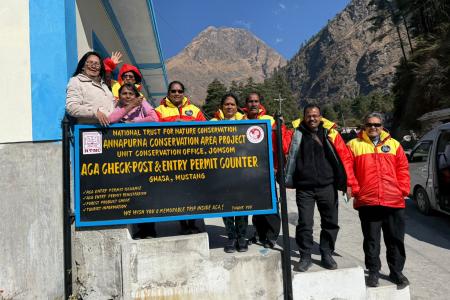
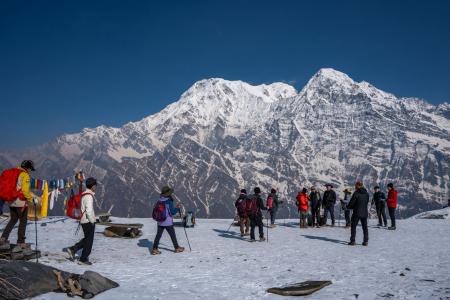
Annapurna region: Annapurna Conservation Area, using TIMS, covering Annapurna Base Camp, the Annapurna Circuit, Poon Hill, and Mardi Himal
Langtang: Langtang National Park, TIMS applies
Manaslu: a restricted area, so guide plus a special permit (Manaslu Circuit Trek)
Upper Mustang, Upper Dolpo, Kanchenjunga, Nar Phu, Tsum Valley: restricted areas with the strictest permit conditions (Upper Mustang Trek)
This lines up with why our trekking permits guide tells you to sort your permit and your guide together under the current system; one doesn't happen without the other, regardless of which permit mechanism your region uses.
Where you still don't need one
A few things fall outside this rule entirely:
- Short day hikes around Kathmandu Valley that don't enter a national park: Shivapuri, Champa Devi, Nagarkot-Dhulikhel
- Pokhara-area walks like Sarangkot or the World Peace Pagoda
- General sightseeing, temple visits, or city touring anywhere in the country
If your trip is a mix of a few valley hikes and a big Himalayan trek, only the trek itself triggers the guide requirement.
What changed in March 2026 and what didn't
There's genuine confusion around a March 2026 update, so it's worth being precise. On March 22–23, 2026, Nepal's Department of Immigration revised its restricted-area permit policy so individual foreign trekkers can now get a permit without first finding a second trekker to apply with; previously, restricted areas like Upper Mustang and Manaslu required a minimum of two applicants. A department spokesperson said the change was meant to remove an inconvenience for tourists that was also hurting tourism promotion.
What this update did not do is remove the guide requirement. A solo applicant can now get the paperwork, but a licensed guide from a registered agency still has to walk the route with them in restricted areas, and everywhere else the rule applies. "Solo" here means solo application, not unguided trekking.
What happens if you skip it
Trekking without a licensed guide on a regulated route isn't a quiet risk;k checkpoints check permits, and permits are now tied to guide registration. Consequences reported by operators and trekkers on the ground include being turned back at a checkpoint, fines, and complications with permit renewal if you're found out of compliance. There's also a practical risk worth taking seriously: if something goes wrong at altitude and you weren't trekking within the legal requirements, your travel insurer may have grounds to dispute a claim.
What a licensed guide actually costs
Guide rates vary by region, season, and experience, but a commonly cited range for a licensed trekking guide booked through a registered agency is USD $25–35 a day, rising to $40–60 a day for more senior or specialized guides. This is usually on top of the permit fees themselves, and most agencies bundle it into a package rate rather than charging it separately.
How to actually hire one
The requirement is specific about who counts: a guide licensed by the Nepal government, working through an agency registered with TAAN. Booking through an established, TAAN-registered operator handles this automatically: permits, guide licensing, and the relevant registration system get sorted as one process rather than something you have to verify piece by piece. If you're planning a specific route, the guide and the permit conditions get worked out together as part of the trip itself; that's the simplest way to make sure nothing gets flagged at a checkpoint halfway up the valley.